- We discussed which cranes are being purchased, their key differentiators, how safety is ensured, and the current progress in digitalization and localization. We will delve into each topic in a dedicated post.
Roundtable participants were asked the following question:
Which cranes are currently in demand?
- ZTM, Alexander Mikhailov
Previously, the market was driven by residential construction and medium-capacity cranes ranging from eight to twenty-five tonnes. Currently, there is higher demand from the industrial and infrastructure sectors, with the most active requests for top-tier models up to two hundred and forty tonnes.
- ZOOMLION, Petr Shishkov
The high-volume class consists of ten-to-twelve-tonne cranes. However, there is steady growth in demand for heavier machinery, sixteen tonnes and above.
- XCMG, Liu Beichen
Ten- and twelve-tonne cranes are leading the segment, as they are best suited for the requirements of Russian residential construction.
- JINNTA, Artem Glukhov
The popular models include a versatile ten-tonne crane with a jib of up to sixteen point five meters, and a higher-capacity twelve-tonne variant. For high-density construction areas, a luffing jib crane is available: it adjusts its angle, requiring less space on site.
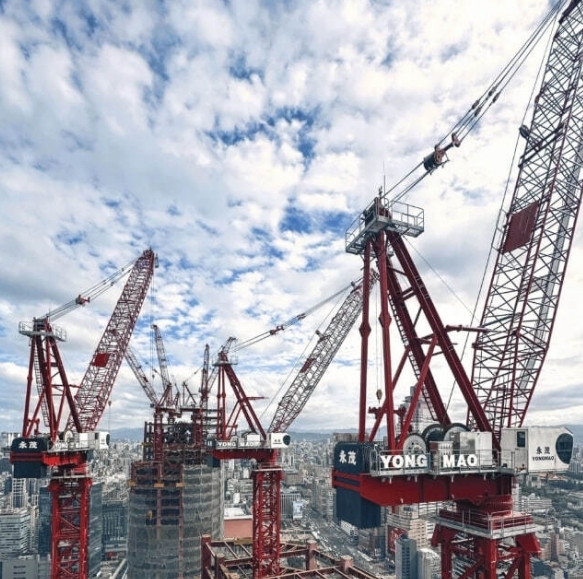
- YONGMAO, Anna Gorda
The sixty-four-tonne model has proven its reliability on the Kerch Bridge and the bridge over the Volga in Tolyatti. The flagship one-hundred-and-sixty-tonne model can withstand hurricane-force winds up to 17 on the Beaufort scale.
- LIUGONG, Oleg Fedorov
Most frequently, eight-to-ten-tonne cranes with a jib of around sixty-five meters are selected. There is growing interest in heavier models: twelve and twenty-six tonnes.
- GIRAFFE, Alexandra Potabaeva
The TDK and SMK series models are in demand: they perfectly balance lifting capacity, jib outreach, and reliability.
Summary: Core demand remains concentrated in the medium-capacity segment, but growth is shifting toward the heavy class. Residential construction continues to purchase ten-to-twelve-tonne cranes, whereas the industrial, energy, and infrastructure sectors are driving demand toward higher-capacity machinery.
Next, we will explore how manufacturers articulate their competitive advantages.
Source