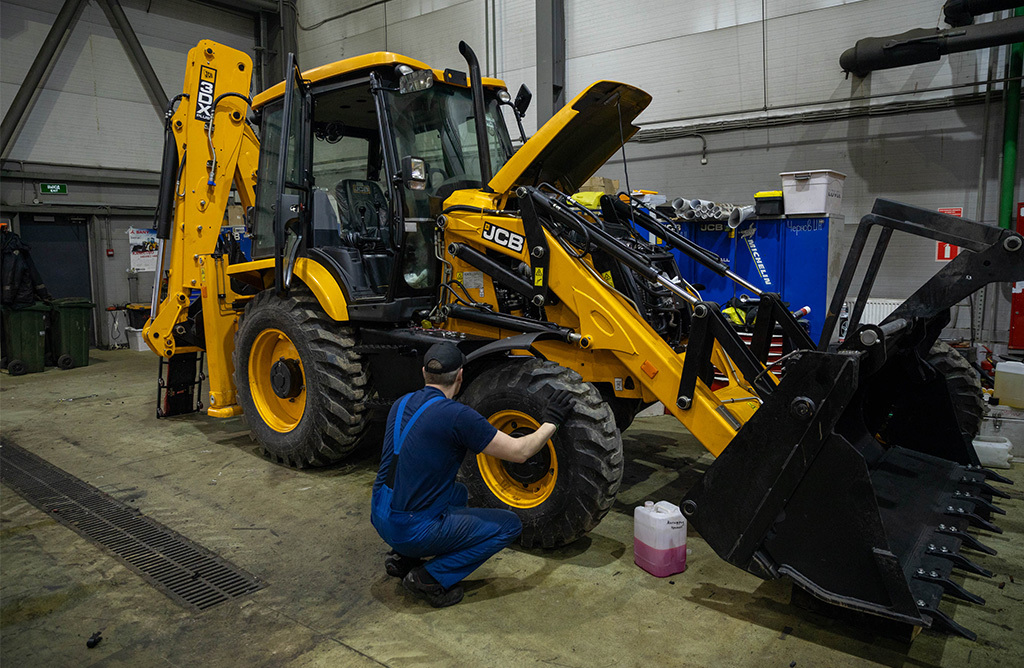
As the sanctions regime will come to an end, service departments of Russian companies will face new challenges, according to Lonmadi. ARMET GROUP stated that, considering all current challenges and industry trends, within the next three to five years, service departments will increasingly move away from the concept of a traditional "repair workshop."
Introducing the Experts
JSC LONMADI is an official supplier of construction machinery from leading global manufacturers, with a history of more than 20 years. The company also provides warranty and post-warranty maintenance for equipment and machinery from brands such as SANY, NFLG, Lovol, JCB, and others.
ARMET GROUP is a company specializing in the comprehensive supply of equipment for the mining industry. It delivers crushing and screening equipment from the ALLIS SAGA plant, produces wear-resistant and spare parts, and provides maintenance services for the supplied machinery.
The discussion included:
We asked our experts just a few questions:
Lonmadi: The amount of counterfeit parts is extremely high, while the demand for the restoration of components and assemblies continues to grow.
Sanctions have complicated the supply of spare parts, led to a shortage of service offerings, and increased the demand for restoration repairs. However, with the end of the sanctions, service departments of Russian companies will face new challenges, according to Vitaly Romashin and Konstantin Romanov.
V. Romashin:
Due to the barriers imposed by unfriendly counterparties and countries, logistics have changed beyond recognition. There is tremendous sanctions pressure on companies that supply many essential goods such as fuels and lubricants, parts, assemblies, tools, and materials. Any operation that was previously simple, such as payment, obtaining permits and other documents, certification, specifying HS codes, or applying the "Honest Sign" labeling, has now turned into a real challenge. Yet even after going through all these steps, there are no guarantees that everything will go according to plan or that the delivery will take place.
Equipment owners have also responded to market changes, and the demand for aggregate repairs has increased. In other words, units that used to be replaced entirely now need to be disassembled, with only specific components being replaced. Sometimes, non-original parts are used in the process. Customers also try not to replace but to restore the working equipment’s levers and rods by using machining or surfacing services. Fuel pumps are disassembled, membranes are replaced, and so on.
K. Romanov:
The demand for the restoration of various components has increased significantly. We primarily attribute this to the longer delivery times for spare parts. In response to these new challenges, our company has not only expanded the range of services offered by the service department through restoration repairs but has also mastered the production of frames and buckets for backhoe loaders, working equipment rods, and other spare parts.
V. Romashin:
Today, in our view, the most in-demand services are precisely those that are currently in short supply: providing a warranty not only for the equipment itself but also for spare parts and comprehensive repair work. The shortage of such services is since dealers themselves lack support from manufacturers, while at the same time bearing enormous costs for warranty programs.
Another major problem today is the availability of genuine spare parts. The amount of counterfeit parts is extremely high.
In these circumstances, the advantage goes to those who can offer equipment owners a full range of products and services that include not only service support but also the restoration and production of parts and assemblies.
K. Romanov:
As for the repair of used and heavily worn equipment, if sanctions remain in place, we do not expect any major changes. However, once new European machines enter the market after the sanctions are lifted, service departments of Russian companies will face new challenges. We anticipate significant changes related to the installation of advanced diagnostic and repair equipment, as well as training mechanics.
Over the past three years, Russian service departments have been unable to maintain the technological level required to service the latest European equipment. These machines operate on electric, hydrogen, and hybrid engines, and we have not yet encountered such repairs very often. Nevertheless, since such equipment will not be able to quickly capture our market due to its high cost and the complexity of independent maintenance, we still have time to train specialists and gain the necessary skills to repair new-generation machinery.
ARMET GROUP: Deep integration of service into the client’s production chain and predictability are the new industry standard.
According to ARMET GROUP experts Ivan Chikov and Alexey Shamychkov, the key trend in the service market is the shift from reactive problem-solving to a proactive partnership model. This is directly reflected in the growing demand for long-term contracts and comprehensive service packages.
I. Chikov:
The market has taken a turn. Companies are no longer interested in simply buying spare parts and repairing equipment only after a failure occurs. The focus has shifted toward ensuring the guaranteed, uninterrupted operation of crushing and screening complexes. This is the right approach, as in the long run it helps save costs and achieve performance targets.
To meet the new standards, we even had to significantly restructure our operations: we nearly doubled our team of service specialists, expanded our regional presence, and established a network of warehouse hubs in key regions.
A. Shamychkov:
Customer behavior has become completely rational. The main demand today is for the predictability of operating costs. This is exactly what my colleague mentioned. For this reason, long-term contracts are being signed more frequently, under which we take responsibility for keeping the equipment in working condition. The service engineer essentially becomes part of the client’s team, planning maintenance based on actual operating hours. This approach significantly reduces downtime risks.
I. Chikov:
Special attention should be given to the contract crushing service that we launched about a year ago. It has become another indicator reflecting the market’s demand for integrated solutions. It is clear that today mining companies want to focus on their core tasks, geological exploration and extraction, while outsourcing the processing of mined material as well as maintenance services.
A. Shamychkov:
Considering all the challenges and trends in the industry, within the next three to five years the service department will look less like a "repair workshop" and more like an analytical center that manages the operational life of equipment in mining sites. That is why we are already seeing growing demand for services that require highly specialized professionals such as automation and process control engineers, maintenance engineers, diagnostic technicians, and experts in servicing complex components of crushing and screening equipment, among others.
I. Chikov:
We can say that we are already moving toward a model in which the dealer’s service department becomes what is known as an efficiency operator for the client. Of course, there is still a lot of work ahead, but our experience with aggregate repairs, full-service contracts, and contract crushing shows that the future belongs to those who strive for the most predictable results possible.
Introducing the Experts
JSC LONMADI is an official supplier of construction machinery from leading global manufacturers, with a history of more than 20 years. The company also provides warranty and post-warranty maintenance for equipment and machinery from brands such as SANY, NFLG, Lovol, JCB, and others.
ARMET GROUP is a company specializing in the comprehensive supply of equipment for the mining industry. It delivers crushing and screening equipment from the ALLIS SAGA plant, produces wear-resistant and spare parts, and provides maintenance services for the supplied machinery.
The discussion included:
- representatives of JSC LONMADI — Vitaly Romashin, Head of the Spare Parts Sales Department, and Konstantin Romanov, Head of the Repair Division in Elino (Central Branch).
- representatives of ARMET GROUP — Ivan Chikov, Chief Operating Officer, and Alexey Shamychkov, Head of the Service Department.
We asked our experts just a few questions:
- What key changes have occurred in the operation of your company’s service department and in the market over the past two to three years?
- What changes in client behavior, requests, and preferences have you noticed?
- How do you envision the model of a successful service department in the next three to five years?
Lonmadi: The amount of counterfeit parts is extremely high, while the demand for the restoration of components and assemblies continues to grow.
Sanctions have complicated the supply of spare parts, led to a shortage of service offerings, and increased the demand for restoration repairs. However, with the end of the sanctions, service departments of Russian companies will face new challenges, according to Vitaly Romashin and Konstantin Romanov.
V. Romashin:
Due to the barriers imposed by unfriendly counterparties and countries, logistics have changed beyond recognition. There is tremendous sanctions pressure on companies that supply many essential goods such as fuels and lubricants, parts, assemblies, tools, and materials. Any operation that was previously simple, such as payment, obtaining permits and other documents, certification, specifying HS codes, or applying the "Honest Sign" labeling, has now turned into a real challenge. Yet even after going through all these steps, there are no guarantees that everything will go according to plan or that the delivery will take place.
Equipment owners have also responded to market changes, and the demand for aggregate repairs has increased. In other words, units that used to be replaced entirely now need to be disassembled, with only specific components being replaced. Sometimes, non-original parts are used in the process. Customers also try not to replace but to restore the working equipment’s levers and rods by using machining or surfacing services. Fuel pumps are disassembled, membranes are replaced, and so on.
K. Romanov:
The demand for the restoration of various components has increased significantly. We primarily attribute this to the longer delivery times for spare parts. In response to these new challenges, our company has not only expanded the range of services offered by the service department through restoration repairs but has also mastered the production of frames and buckets for backhoe loaders, working equipment rods, and other spare parts.
V. Romashin:
Today, in our view, the most in-demand services are precisely those that are currently in short supply: providing a warranty not only for the equipment itself but also for spare parts and comprehensive repair work. The shortage of such services is since dealers themselves lack support from manufacturers, while at the same time bearing enormous costs for warranty programs.
Another major problem today is the availability of genuine spare parts. The amount of counterfeit parts is extremely high.
In these circumstances, the advantage goes to those who can offer equipment owners a full range of products and services that include not only service support but also the restoration and production of parts and assemblies.
K. Romanov:
As for the repair of used and heavily worn equipment, if sanctions remain in place, we do not expect any major changes. However, once new European machines enter the market after the sanctions are lifted, service departments of Russian companies will face new challenges. We anticipate significant changes related to the installation of advanced diagnostic and repair equipment, as well as training mechanics.
Over the past three years, Russian service departments have been unable to maintain the technological level required to service the latest European equipment. These machines operate on electric, hydrogen, and hybrid engines, and we have not yet encountered such repairs very often. Nevertheless, since such equipment will not be able to quickly capture our market due to its high cost and the complexity of independent maintenance, we still have time to train specialists and gain the necessary skills to repair new-generation machinery.
ARMET GROUP: Deep integration of service into the client’s production chain and predictability are the new industry standard.
According to ARMET GROUP experts Ivan Chikov and Alexey Shamychkov, the key trend in the service market is the shift from reactive problem-solving to a proactive partnership model. This is directly reflected in the growing demand for long-term contracts and comprehensive service packages.
I. Chikov:
The market has taken a turn. Companies are no longer interested in simply buying spare parts and repairing equipment only after a failure occurs. The focus has shifted toward ensuring the guaranteed, uninterrupted operation of crushing and screening complexes. This is the right approach, as in the long run it helps save costs and achieve performance targets.
To meet the new standards, we even had to significantly restructure our operations: we nearly doubled our team of service specialists, expanded our regional presence, and established a network of warehouse hubs in key regions.
A. Shamychkov:
Customer behavior has become completely rational. The main demand today is for the predictability of operating costs. This is exactly what my colleague mentioned. For this reason, long-term contracts are being signed more frequently, under which we take responsibility for keeping the equipment in working condition. The service engineer essentially becomes part of the client’s team, planning maintenance based on actual operating hours. This approach significantly reduces downtime risks.
I. Chikov:
Special attention should be given to the contract crushing service that we launched about a year ago. It has become another indicator reflecting the market’s demand for integrated solutions. It is clear that today mining companies want to focus on their core tasks, geological exploration and extraction, while outsourcing the processing of mined material as well as maintenance services.
A. Shamychkov:
Considering all the challenges and trends in the industry, within the next three to five years the service department will look less like a "repair workshop" and more like an analytical center that manages the operational life of equipment in mining sites. That is why we are already seeing growing demand for services that require highly specialized professionals such as automation and process control engineers, maintenance engineers, diagnostic technicians, and experts in servicing complex components of crushing and screening equipment, among others.
I. Chikov:
We can say that we are already moving toward a model in which the dealer’s service department becomes what is known as an efficiency operator for the client. Of course, there is still a lot of work ahead, but our experience with aggregate repairs, full-service contracts, and contract crushing shows that the future belongs to those who strive for the most predictable results possible.